Cibolo, TX · Epoxy Garage Floors
Epoxy Garage Floors in Cibolo, Texas
Epoxy is still the word most people use for any coated garage floor, and professionally installed epoxy has a real place — as a thick, bonding base coat. The trouble starts when a thin epoxy is used on its own, on an unprepared slab, in a Texas garage.
01 — What this covers
The work itself
- 100% solids epoxy base coats
- Epoxy with full flake broadcast
- Solid-color epoxy with clear topcoat
- Moisture-mitigating epoxy primers
- Replacement of peeling DIY epoxy
- Epoxy for workshops and home gyms
- Matching coating for steps and stem walls
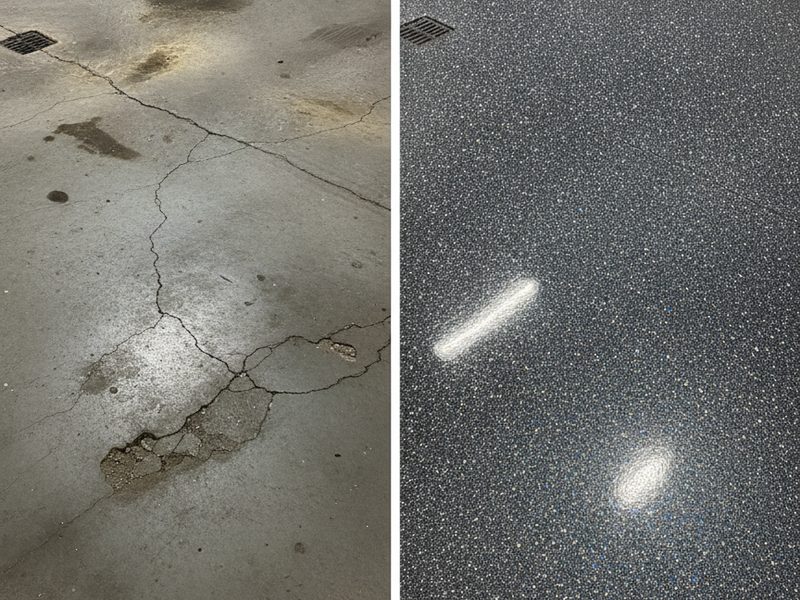
Illustrative image of the finish — not a photograph of a specific local project.
02 — Detail
Not all epoxy is the same product
The label says epoxy on a forty-dollar kit and on a professional two-part system that costs many times more per gallon, and the two have little in common. The key figure is solids content. Water-based epoxies contain a large share of water that evaporates as they cure, leaving a thin film. A 100% solids epoxy has nothing to evaporate: what you roll on is what stays, so a single coat builds real thickness.
Thickness is what lets a coating bridge small surface imperfections, resist impacts from dropped tools and stand up to years of tires. Professional installers talk in mils — thousandths of an inch — and a serious system is several times thicker than a kit.
That thickness also hides surface flaws in the concrete better, which is why epoxy remains a popular base coat even in systems finished with polyaspartic.
03 — Detail
Where epoxy struggles in a Texas garage
Epoxy has two weak points that matter here. The first is UV exposure: many epoxies amber or yellow when sunlight reaches them, and in a garage that faces west with the door open on summer afternoons, it does. On a dark solid color you may barely notice; on a light grey you will.
The second is heat and hot tires. A softer epoxy finish can mark or lift under tires that have just come off a highway in July, especially if the bond to the concrete was weak to begin with. That is why most installers now top an epoxy base with a harder polyaspartic or polyurethane clear coat instead of leaving epoxy as the wearing surface.
Cure time is the third practical difference. Epoxy typically needs longer before you can drive on it, so plan on the garage being out of use for a few days rather than one.
04 — Detail
Replacing a peeling DIY floor
A good share of the epoxy calls in this area are about floors that were coated once already, usually from a kit, and are now coming apart in the tire tracks. The fix is not another coat on top. Anything laid over a failing coating inherits its weak bond, so the old material has to be ground off back to clean concrete.
That removal is real work and it is the main reason two garages of the same size can get very different estimates. It is also an opportunity: once the slab is ground clean, every crack and stain is visible and can be dealt with properly before the new system goes down.
If you are not sure whether your floor was ever coated, look along the walls and in the corners. A clear or colored film that flakes when scraped, or a sharp line where color stops, usually means it was.
05 — Detail
Workshops, gyms and heavy use
Epoxy's thickness and impact resistance make it a good fit for garages that work hard — woodworking shops, home mechanics with floor jacks and creepers, and home gyms where weights occasionally hit the floor. For those, a thicker base coat and a tougher topcoat are worth more than an extra decorative feature.
Rubber gym mats can sit directly on a coated floor. Jack stands and kickstands are better on a small plate to spread the load, the same as on bare concrete.
If the space doubles as a workshop, talk about chemical exposure too. Brake fluid, some solvents and battery acid are hard on many coatings; the right topcoat choice depends on what actually gets spilled.
How we work
Step by step
- 01
Tell us the garage size and what the floor looks like now
- 02
An installer checks the concrete, any old coating, and moisture
- 03
The slab is diamond-ground and repaired
- 04
Epoxy base coat, optional flake, and a protective clear topcoat
- 05
Cure time explained before you move anything back in
What it costs
Epoxy-based systems are priced by area and condition, like any coating. A thin single coat is cheap and rarely worth it; a multi-coat system with a durable topcoat costs more and is the version that lasts. Your estimate should list every coat.
Questions
Epoxy Garage Floors — asked and answered
How long does an epoxy garage floor last?
A properly prepared, multi-coat system with a durable topcoat can last many years in a residential garage. A thin kit applied over unground concrete often starts peeling within one or two summers. Preparation and topcoat choice matter more than the brand name.
Why do epoxy floors peel?
Almost always because of weak adhesion: the slab was not ground, it was contaminated with oil or sealer, or moisture was coming up through the concrete. Hot tires then pull the weakly bonded coating up where the car parks.
Does epoxy turn yellow?
Many epoxies amber with UV exposure, which is why professional systems usually add a UV-stable polyaspartic or polyurethane topcoat over the epoxy base.
How soon can I park on an epoxy floor?
It depends on the product and temperature, but epoxy systems usually need several days before vehicles. Your installer should give you a specific time for the system they use.
Also
Other coating services
Garage Floor Coating
A polyaspartic flake coating turns a stained, dusty garage slab into a hard, glossy floor that cleans with a m…
Metallic Epoxy Floors
Metallic epoxy uses pigments that swirl and reflect light to create a marbled, almost liquid look. It is the m…
Concrete Patio Coating
Outdoor concrete has a harder life than a garage floor: full sun, rain, temperature swings and bare feet. A pa…
Driveway Coating & Sealing
A driveway carries the weight of every vehicle, bakes in full sun and drains the rain off your lot. The right …
Pool Deck Coating
A pool deck has to be cool on bare feet, grip when wet and stand up to chlorine, sun and constant water. When …
Stained & Decorative Concrete
Not every concrete floor needs a thick coating. Stains, dyes and thin decorative overlays can transform plain …
Commercial & Shop Floors
Small warehouses, auto shops, retail floors, gyms and barns all need concrete that is easy to clean, resists w…
Service area